Male Master Embroiderers

Japan: japanese embroidery- Kurenai-kai

Iwao Saito (1918-1989)  - Founder and Master Embroiderer

USA: japanese embroidery center

China: Hair embroidery masters

Ming Yongguo – http://www.mygart.net/main/assume_e.asp

Ming Yongguo´s work

Wei Jingxian – http://www.wjxart.com/Professor.htm

sample of Wei Jingxian´s hair embroidery:

Tibet: Themba Chophel, master appliqué thangka tailor of Norbulingka Institute, India

copyright Norbulingka Institute

Urgyen Sonam, Australia, Tibetan Sacred Arts

copyright Tibetan Sacred Arts Urgyen Sonam

 Dorjee Wangdu, Tibetan Appliquéd Thangka artist and master, Tibetan Applique Arts

India: Asif, master embroiderer

England: Owen Davies, creator of Knotwork Garden Embroidery and former head of the Royal School of Needlework

Kaffe Fassett, textile artist, kaffefassett.com

copyright Kaffe Fassett

France: Francois Lesage, designer of haute coutre embroidery,  Ecole Lesage

embroiderers of Jean-Francois Lesage´s “House of Lesage“, hand-embroidered textiles for interior designs

Greece: Dimitri Castano, Gold Embroidery master and designer, www.gold-embroidery.com

Spain: Juan Rosén, master goldwork embroiderer, http://www.artenetmalaga.com/

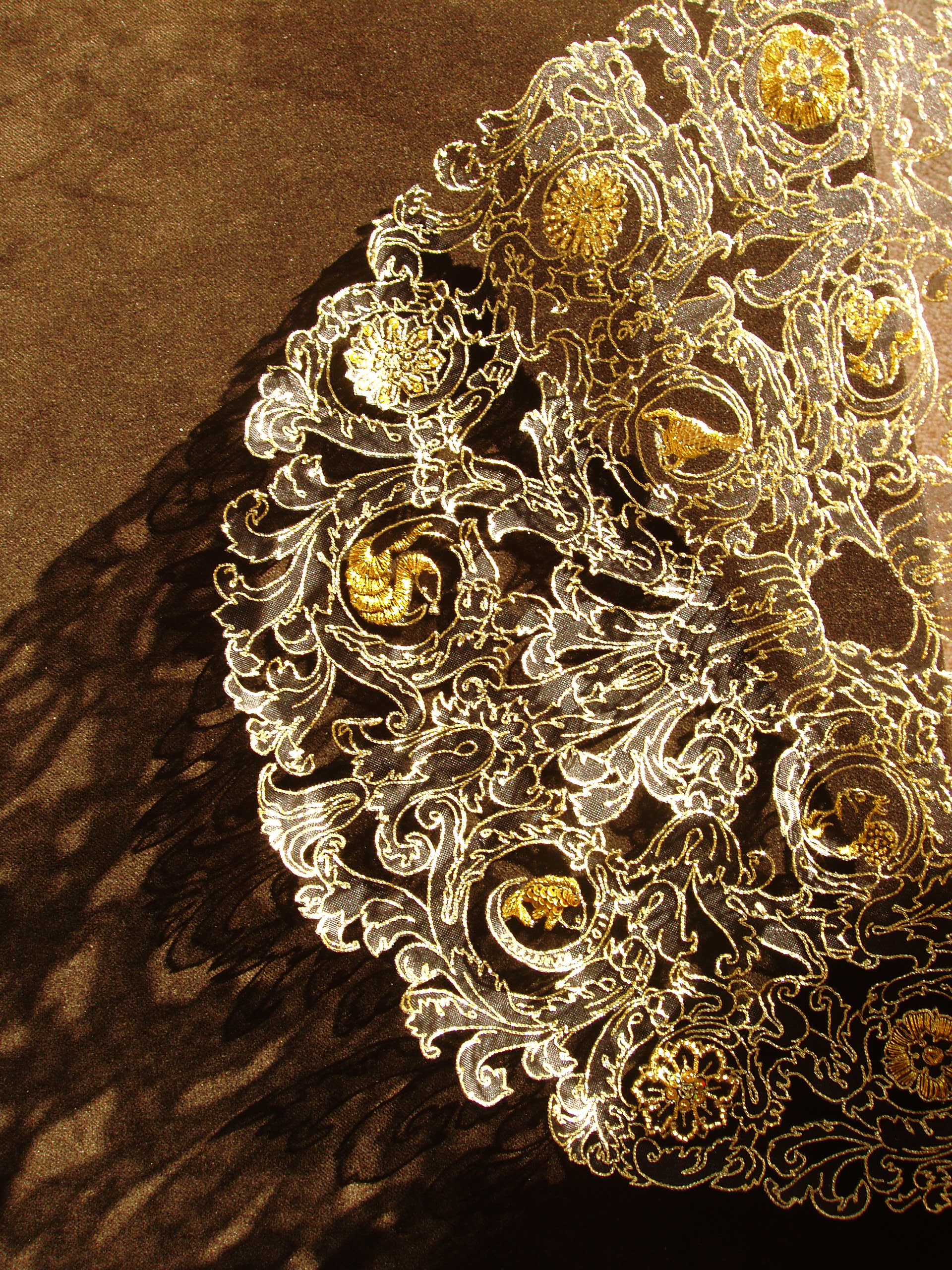
Sample of embroidery from the Juan Rosén Goldwork Embroidery Studio

Sebastían Marchante, master goldwork embroiderer and artist

sample of his design

copyright Sebastían Marchante

Laos Prince  Nithtakhong Somsanith, royalty, embroiderer, artist – http://www.princesomsanith.com/aboutSomsanith.jsp

Royal embroideries:

Lima, Peru – Paul Phillip Evans, haute couture designer and embroiderer, http://www.paulphillipevans.com/ 

http://bordadodelujo.blogspot.com/

Comments (2) »

Lessons in Making a Tibetan Silk Thangka (also Fabric Thangka, Appliqué Thangka)

I will try to document (in all discretion) my progress in the silk thangka lessons with Leslie Rinchen-Wongmo. Visit www.silkthangka.com to see her thangkas and to enrol in her lessons, or purchase prints and the DVD “Creating Buddhas”.

Lesson 1: Selection of Fabrics and Stabilization processes

Silk Fabrics and a Leslie Rinchen-Wongmo print

Silk Fabrics and a Leslie Rinchen-Wongmo print available at www.silkthangka.com

(October 14, 2009)

The best fabric for silk thangkas are silk satin, silk brocades and silks. In this lesson, we learn more about silk, and how much the Tibetans value silk and include it as one of the best offerings in their rites.

white dragon silk brocade

white dragon silk brocade

There are several options in stabilizing the fabrics to make them easier to handle, especially if the fabrics will be cut in very small pieces of intricate shapes

Stabilized fabrics

Stabilized fabrics

Lesson 2: Drawing (and Transfering of Design on Fabric)
Lesson 2 Transfer Drawing to Fabric
Lesson 3: Making Horsehair and silk cords
From left to right: blue and pink cords made by my teacher using silk threads from India, beige and brown cords made with Gütermann silk sewing machine threads, and yellow cords made with vintage silk embroidery threads (Elga/VEB Alwo Brand/Germany)

Comments (1) »

My 2nd Weaving Sampler

Started Nov. 4, 2009

Materials: Lisa yarns (Acrylic)

I am starting to make this sampler of woven patterns, because sometimes I feel like there is a weaver inside of me, that longs to weave. I am learning a lot, and I indulge in the process. It is a really time-consuming textile-making technique. I forget the time when I am on my table loom. Weaving has become therapeutic.

I will learn some pattern combinations, colors and perhaps materials. Right now, my loom has a rigid heddle. I have to devise temporary heddles before the rigid heddle, if I want to make complicated patterns. I will try one experiment with all three colors.

I am using cheap acrylic yarn for the weft. The warp is single thread of old white crochet yarn. I bought my Kirchner table loom from eBay. I actually first learned to weave using a foot loom early this spring. Table loom is so slow, but I get to learn a lot of the basics and I know what I will be looking for when I start looking for a larger loom with pedals and 8 harnesses.

Nov. 7, 2009 progress

First Rows

Nov. 7, 2009 Update 8 hours

 Nov. 20, 2009 update: Up to now, these are all variations using 2 string heddles. Something is strange with my camera. These are the same yarns, but the colors look different in both pictures. The latest photo is truer to life. I actually chose a cooler palette.


November 26, 2009 Update: This is going very fast. I am almost at the end of the 2 meter warps. This photo shows variations on a simple pattern using 2 shafts.


Leave a comment »

Embroidery techniques I want to learn:

Click on the names to visit a website:

1. tambour work or crochet du Lunéville I am learning this technique as of July 13, 2009.

2. japanese embroidery - I plan to take my first courses from a german certified teacher in Cologne this coming May 2010.

Japanese embroidery Center USA copyright

3. Totsuka Shisyu - I already made contact with Totsuka Embroidery Institute in Japan and I ordered books already. I plan to go to Japan and take instructions there in 2011. I will start to learn japanese language in 2010.

Totsuka Shisyu copyright

Totsuka Shisyu copyright

4. Silk Thangka appliqué I am currently enrolled in the online course on making silk thangkas. (Oct. 06, 2009)

Silk thangka by Leslie Rinchen-Wongmo copyright

Silk thangka by Leslie Rinchen-Wongmo copyright

5. silk embroidery – Fil de soie I am already learning this needlepainting technique. (Nov.15, 2009).
endora
copyright EndOra
6. Stumpwork and Ribbonwork – I might buy books, DVDs and kits starting 2010.
7. Kalaga (Burmese or Thai wall hangings)
8. Peranakan beaded embroidery – I visited this little shop in Bugis. The lessons there cost about 200$ for 2 lessons.
9. Kutch Embroidery (india)
10. Torero Goldwork embroidery

copyright Luis Calleja

Leave a comment »

My 2009 London Vacation Part 2: Textiles in Horniman Museum (temporary exhibit)

At the Horniman Gardens and Museum, they have thousands of textiles in their collections and parts of which are shown every season. During our visit in October, 2009, embroidered chinese silks were exhibited and presented as important symbols in the society and of time.  here are some of the photos I have taken.

China Symbols in Silk poster

Very difficult to make good photos in the dimmed room.

fine goldwork on a black satin robe

Samplers of the stitches used in chinese embroideries:

Stitch sampler 1

The samples are stitched in larger formats to show how it is done.

Very fine embroideries:

More imperial embroideries:

Detail of a large appliqued and embroidered wall hanging:

Descriptions of Buddhist symbols:


Leave a comment »

Suzhou Chinese silk embroidery kits from Endora (France)

The kits arrived yesterday. It was difficult looking for kits with photographs and instructions on finishing the designs. You can order your kits and threads here: http://www.fildesoie.fr/

The kits from Endora includes a general instruction in French, but not on finishing the project. No instructions showing which colors and stitches are used on which parts. You will find more than enough divisible silk threads. The design is printed on satin (or a fabric that looks like satin). I washed this satin in warm water so I can iron flat the folds. BE CAREFUL. I can´t tell whether the sticky substance came from the print or the satin itself. I believe it is a stabilizer to stiffen the fabric. But it can also be the paint for the print, which means if one is not careful, the print would stick to your iron or whatever you use to cover it while ironing. Set iron on the lowest heat. Cover it with clean cloth to protect the print from higher heat.

The kits are not for total embroidery beginners, if one wants to produce the highquality needlepainted embroideries of Suzhou. But beginners can give it a try. This is my first silk embroidery and silk needlepainting. I have done smaller needlepainted embroideries in my Totsuka projects before, but in cotton.

 My process: I sketched the stitch directions first. And then another sketch for the colors. I also took another digital photo of the printed satin, for details. I can enlarge the photo on my computer to show finer details, like the whiskers and highlights in the eyes. When stitching, most of the fine details will get covered, so these digital photos will be helpful when locating the placement of the final details.

I suggest mixing colors to have a more gradual change of shades. Needlepainting is one of the most difficult to master in embroidery, because one also has to have skills in colorshading. And those who know me, know I am colorblind. So this is really a great challenge for me. 

P1010002

Endora kit Chat03

 After ironing the fabrics:

P1010005

Comments (1) »

Totsuka embroidery “Kabuto” (traditional japanese military helmet)

A Kabuto symbolizes the strong and healthy boy, which is why it is brought out during Boys´Day, which was celebrated in Japan, every 5th of May. Girls Day, or Hinamatsuri, was celebrated on the 3rd day of March . Boys´Day was also called Tango no Sekku, which is one of the seasonal festivals, this one marking the beginning of the rainy season or the summer. On Boys´Day, a Kabuto helmet is displayed, or a Kintaro doll riding a giant carp. Kintaro is the childhood name of a samurai hero, known for his strength even while still a young boy.

Boys´Day is also known as feast of the banners. On the day before this day,  families raise colorful carp-shaped flags called koinobori, each carp representing a boy or a child in the family.

In 1948, the japanese government declared the day Children´s Day, Kodomo no hi.

I am making this design from a Totsuka embroidery book, which comes only in japanese. My teacher Kayo helped me with the translations last 2007 a few days before she went back to Japan. Thank you to Kayo-sensei, my first Totsuka embroidery teacher. Totsuka shisyu suggests Cosmo cotton embroidery threads, but I convert them to DMC or Anchor.

You can visit their website, which is only in japanese, here: http://www.totsuka-shisyu.com/

"Kabuto" November 7, 2009 after 6 hours

Kabuto November 7, 2009 after 6 hours

Leave a comment »

My 2009 London Vacation Part 4: Walks around London

October 19 – 21, 2009

This is a great place and the hosts were very kind. It is walking distance to Oxford Street, Hyde Park, Regent Park and Buckingham Palace. We also walked all the way to the Victoria & Albert Museum.

Bed and Breakfast accomodation

Bed and Breakfast accomodation

The London Eye, Parliament and the Big Ben in the background.

P1010085


Harrods – on the way to Victoria & Albert Museum, this store is literally a palace. It is like Disneyland for the adults.

P1010210


Ripley´s Believe it or not, Picadilly Circus

P1010211


Chinatown, Soho – lots of Asians spend free time here with friends.

P1010212


Buckingham Palace – surrounding the palace are beautiful gardens. There is the ceremony of changing of the guards at 11:30am.

P1010247


Tower-Bridge – further left is the Tower of London, where many traitors, queens and kings were imprisoned.

P1010249


Die Gurke/30 St Mary Axe/ Swiss Re

Read more about London´s top ten modern architecture here.

P1010251

Leave a comment »

My 2009 London Vacation Part 3: the Royal School of Needlework Foundation Degree Open Day

P1010228

Hampton Court Palace, home of the Royal School of Needlework.

P1010226

The RSN offices and studios are at the apartments at the back part of the court facing the beautiful garden of trimmed trees(1). The new degree classrooms are on the right side of the court, the upper levels, facing the beautiful baroque garden (2).

P1010229


Unfortunately, I did not take any photos during Mr. James Hunting´s and the other staff´s presentation of the Foundation Degree. This is the only photo I took of the hallway going to the rooms.

P1010236 

Several teenagers showed up for the open day presentation of the degree. The principal of RSN, Dr. Susan Kay-Williams, James Hunting, the course leader of the degree and a teacher of stitches welcomed us. They explained to us what the course is about. The apprenticeship program does not exist anymore. The Foundation Degree Program replaced that. It is connected with the UCA, which means the students enrolls through the UCA, get accepted as a university student and has all the rights as a regular student has, like loans and accomodation help.  The program lasts 2 years and it is fulltime intensive stitching and theory combined. In the second year students will be introduced to companies and individuals involved in textiles, costumes or designs. Students will learn about putting up their own business or how to get jobs in the textile industry or in theater or fashion industry.

 We have met some of the first batch of students enrolled  in the Foundation Degree program. One of which, I am subscribed to her blog. She is working on a stitched Braille linen work.

Unfortunately, the “tempting” RSN shop was closed during my visit. No tours to the collections either, I was not able to see the needleworks. But I was able to see some stitchers working through the windows of the studios.

After the presentation, we were able to go in the palace itself, through the reenacted medieval scenes with costumed staffs and simulated sounds of the medieval workers and shops.

 P1010238

Leave a comment »

My 2009 London Vacation Part 1: Needlework shops and Fabric Stores

To the stitchinfingers.ning.com members, who replied with addresses of stores with needleworks or haberdashery departments, or needlework shops around London, thank you. I was able to visit all of them.

I am writing this blog entry, for those who are visiting London and would want to look for fabrics and needlework stuffs. This is not a complete list, so if anyone has to share, I will add another list of shops I have not visited. Before I got hold of the AtoZ London map book, I used the Google map to locate the addresses, I would recommend using that when you are online.

 1. All the Fun of the Fair is a little store on the 2nd Floor of 8 Kingly Court. They have mostly knitting stuffs. The shop has the feel of a cake shop, maybe because of the knitted muffins. Visit their website for photos.

2. Broadwick Silks is along Broadwick Street.

Broadwick Silks Ltd

Broadwick Silks Ltd


3. The Silk Society’s website has the same design as the Broadwick Silks Ltd. It is a different store.

The Silk Society

The Silk Society


4.The Cloth House is a very warm place with lots of vintage fabrics, great prices too. They have a great website and another blogger has written about the shop. http://www.fashion-stylist.net/blog/2008/03/06/the-cloth-house-and-buttons/

Cloth House

Cloth House


5. The Soho Silks is located in D´Arblay St.
Soho Silks
Soho Silks


 6. The Liberty& Co. of London is located at Great Marlborough Street. It is a large store. The haberdashery section is in the 3rd floor

Liberty & Co of London
 
  7. John Lewis is one of the most visited store located along Oxford Street. Go to the Haberdashery Section on the 4th Floor.
John Lewis

John Lewis

8. MacCullogh and Wallis is located at Dering Street.
MacCulloch and Wallis

MacCulloch and Wallis

9. The London Bead Co. /Delicate Stitches, I like this store because it is the only one which sells embroidery books, including Inspirations magazines. They have american tools and threads, which the other stores have none. I recommend this store, although not located in the busy Soho area. It is really worth the time going there. I was told at the RSN and by a friend, that they are probably only beads there. But if one goes inside to the other half of the store, one sees the reason why the name of the store has a slash then Delicate Stitches to it. :)
The London Bead Co./Delicate Stitches

The London Bead Co./Delicate Stitches

Leave a comment »